Search any question & find its solution
Question:
Answered & Verified by Expert
A particle is exhibiting simple harmonic motion has its displacement $x$ and velocity $v$ related as $4 v^2=25-x^2$. The time period of SHM is
Options:
Solution:
2474 Upvotes
Verified Answer
The correct answer is:
$4 \pi \mathrm{s}$
Given that, $4 v^2=25-x^2 \Rightarrow v^2=\frac{1}{4}\left(25-x^2\right)$
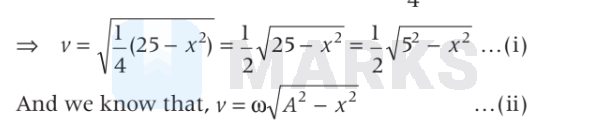
So, on comparing Eqs. (i) and (ii), we get Angular frequency, $\omega=\frac{1}{2} \mathrm{rad} / \mathrm{s}$ Amplitude, $A=5 \mathrm{~m}$ So, time period, $T=\frac{2 \pi}{\omega} \Rightarrow T=\frac{2 \pi}{(1 / 2)} \Rightarrow T=4 \pi \mathrm{s}$
So, on comparing Eqs. (i) and (ii), we get Angular frequency, $\omega=\frac{1}{2} \mathrm{rad} / \mathrm{s}$ Amplitude, $A=5 \mathrm{~m}$ So, time period, $T=\frac{2 \pi}{\omega} \Rightarrow T=\frac{2 \pi}{(1 / 2)} \Rightarrow T=4 \pi \mathrm{s}$
Looking for more such questions to practice?
Download the MARKS App - The ultimate prep app for IIT JEE & NEET with chapter-wise PYQs, revision notes, formula sheets, custom tests & much more.