Search any question & find its solution
Question:
Answered & Verified by Expert
A particle of mass $5 \mathrm{~m}$ at rest suddenly breaks on its own into three fragments. Two fragments of mass m each move along mutually perpendicular direction with each speed v. The energy released during the process is
Options:
Solution:
1103 Upvotes
Verified Answer
The correct answer is:
$\frac{4}{3} m v^2$
The particle of mass $5 \mathrm{~m}$ breaks in three fragments of mass $m, m$ and $3 \mathrm{~m}$ respectively. Two fragments of mass meach, move in perpendicular direction with velocity $v$ and the left fragment will move in a direction with velocity $v^{\prime}$ such that the total momentum of the system must remain conserved.
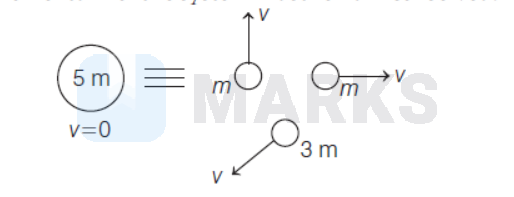
By law of conservation of momentum,
$$
\begin{aligned}
5 \mathrm{~m} \times 0 & =\mathrm{mv} \hat{\mathrm{i}}+\mathrm{mv} \hat{\mathrm{j}}+3 \mathrm{mv}^{\prime} \\
\Rightarrow \quad \mathrm{v}^{\prime} & =-\frac{\mathrm{v}}{3} \hat{\mathrm{i}}-\frac{\mathrm{v}}{3} \hat{\mathrm{j}} \\
\therefore \quad\left|\mathrm{v}^{\prime}\right| & =\sqrt{\left(-\frac{\mathrm{v}}{3}\right)^2+\left(-\frac{\mathrm{v}}{3}\right)^2}=\frac{\mathrm{v} \sqrt{2}}{3}
\end{aligned}
$$
$\therefore$ Energy released
$$
\begin{aligned}
\mathrm{E} & =\frac{1}{2} m v^2+\frac{1}{2} m v^2+\frac{1}{2} \times 3 \mathrm{~m}\left(\frac{\mathrm{v} \sqrt{2}}{3}\right)^2 \\
& =m v^2+\frac{m v^2}{3}=\frac{4}{3} m v^2
\end{aligned}
$$
By law of conservation of momentum,
$$
\begin{aligned}
5 \mathrm{~m} \times 0 & =\mathrm{mv} \hat{\mathrm{i}}+\mathrm{mv} \hat{\mathrm{j}}+3 \mathrm{mv}^{\prime} \\
\Rightarrow \quad \mathrm{v}^{\prime} & =-\frac{\mathrm{v}}{3} \hat{\mathrm{i}}-\frac{\mathrm{v}}{3} \hat{\mathrm{j}} \\
\therefore \quad\left|\mathrm{v}^{\prime}\right| & =\sqrt{\left(-\frac{\mathrm{v}}{3}\right)^2+\left(-\frac{\mathrm{v}}{3}\right)^2}=\frac{\mathrm{v} \sqrt{2}}{3}
\end{aligned}
$$
$\therefore$ Energy released
$$
\begin{aligned}
\mathrm{E} & =\frac{1}{2} m v^2+\frac{1}{2} m v^2+\frac{1}{2} \times 3 \mathrm{~m}\left(\frac{\mathrm{v} \sqrt{2}}{3}\right)^2 \\
& =m v^2+\frac{m v^2}{3}=\frac{4}{3} m v^2
\end{aligned}
$$
Looking for more such questions to practice?
Download the MARKS App - The ultimate prep app for IIT JEE & NEET with chapter-wise PYQs, revision notes, formula sheets, custom tests & much more.