Search any question & find its solution
Question:
Answered & Verified by Expert
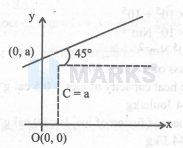
A particle of mass ' $\mathrm{m}$ ' is moving along a line $\mathrm{y}=\mathrm{x}+\mathrm{a}$ with a constant velocity ' $v$ '. The angular momentum of the particle about the origin is
Options:
Solution:
2532 Upvotes
Verified Answer
The correct answer is:
$\frac{\text { mva }}{\sqrt{2}}$
Given, $\mathrm{y}=\mathrm{x}+\mathrm{a}$
compairing with $\mathrm{y}=\mathrm{mx}+\mathrm{c}$
$$
\begin{aligned}
& \mathrm{m}=1, \mathrm{c}=\mathrm{a} \\
& \tan \theta=1=\tan 45^{\circ} \\
& \theta=45^{\circ}
\end{aligned}
$$
The velocity in vector form
$$
\begin{aligned}
\vec{v} & =v \cos \theta \hat{\mathrm{i}}+v \sin \theta \hat{\mathrm{j}}=v \cos 45 \hat{\mathrm{i}}+v \sin 45 \hat{\mathrm{j}} \\
& =\frac{v}{\sqrt{2}}(\hat{\mathrm{i}}+\hat{\mathrm{j}})
\end{aligned}
$$
Let us assume particle is at point $(0, a)$ $\overrightarrow{\mathrm{r}}=(0-0) \hat{\mathrm{i}}+(\mathrm{a}-0) \hat{\mathrm{j}}=\mathrm{a} \hat{\mathrm{j}}$
Angular momentum,
$$
\begin{aligned}
& \overline{\mathrm{L}}=m(\overrightarrow{\mathrm{r}} \times \overrightarrow{\mathrm{v}}) \\
& =m\left(a \hat{\mathrm{j}} \times \frac{v}{\sqrt{2}}(\hat{\mathrm{i}}+\hat{\mathrm{j}})\right)=\frac{m v a}{\sqrt{2}}(-\hat{\mathrm{k}})
\end{aligned}
$$
compairing with $\mathrm{y}=\mathrm{mx}+\mathrm{c}$
$$
\begin{aligned}
& \mathrm{m}=1, \mathrm{c}=\mathrm{a} \\
& \tan \theta=1=\tan 45^{\circ} \\
& \theta=45^{\circ}
\end{aligned}
$$
The velocity in vector form
$$
\begin{aligned}
\vec{v} & =v \cos \theta \hat{\mathrm{i}}+v \sin \theta \hat{\mathrm{j}}=v \cos 45 \hat{\mathrm{i}}+v \sin 45 \hat{\mathrm{j}} \\
& =\frac{v}{\sqrt{2}}(\hat{\mathrm{i}}+\hat{\mathrm{j}})
\end{aligned}
$$
Let us assume particle is at point $(0, a)$ $\overrightarrow{\mathrm{r}}=(0-0) \hat{\mathrm{i}}+(\mathrm{a}-0) \hat{\mathrm{j}}=\mathrm{a} \hat{\mathrm{j}}$
Angular momentum,
$$
\begin{aligned}
& \overline{\mathrm{L}}=m(\overrightarrow{\mathrm{r}} \times \overrightarrow{\mathrm{v}}) \\
& =m\left(a \hat{\mathrm{j}} \times \frac{v}{\sqrt{2}}(\hat{\mathrm{i}}+\hat{\mathrm{j}})\right)=\frac{m v a}{\sqrt{2}}(-\hat{\mathrm{k}})
\end{aligned}
$$
Looking for more such questions to practice?
Download the MARKS App - The ultimate prep app for IIT JEE & NEET with chapter-wise PYQs, revision notes, formula sheets, custom tests & much more.