Search any question & find its solution
Question:
Answered & Verified by Expert
(a) Pressure decreases as one ascends the atmosphere. If the density of air is $\rho$, what is the change in pressure $d p$ over a differential height $d h$ ?
(b) Considering the pressure $p$ to be proportional to the density, find the pressure $p$ at a height $h$ if the pressure on the surface of the earth is $p_0$.
(c) If $p_0=1.03 \times 10^5 \mathrm{Nm}^{-2}, \rho_0=1.29 \mathrm{~kg} \mathrm{~m}^{-3}$ and $g=9.8$ $\mathrm{ms}^{-2}$, at what height will be pressure drop to $(1 / 10)$ the value at the surface of the earth?
(d) This model of the atmosphere works for relatively small distances. Identify the underlying assumption that limits the model.
(b) Considering the pressure $p$ to be proportional to the density, find the pressure $p$ at a height $h$ if the pressure on the surface of the earth is $p_0$.
(c) If $p_0=1.03 \times 10^5 \mathrm{Nm}^{-2}, \rho_0=1.29 \mathrm{~kg} \mathrm{~m}^{-3}$ and $g=9.8$ $\mathrm{ms}^{-2}$, at what height will be pressure drop to $(1 / 10)$ the value at the surface of the earth?
(d) This model of the atmosphere works for relatively small distances. Identify the underlying assumption that limits the model.
Solution:
1732 Upvotes
Verified Answer
Let us consider a horizontal parcel of air with crosssection $A$ and thickness $(d h)$. As the pressure at a point in fluid is equal in all direction.
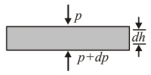
So the pressure on the upper surface $(p)$ is downward and on bottom surface $(p+d p)$ upward if the parcel is in equilibrium, then the net upward force must be balanced by the weight and Buoyant force by air.
i.e. $(p+d p) A-p A=-\rho g A d h$
$$
\begin{aligned}
&(\because \text { Weight }=\text { Density } \times \text { Volume } \times g) \\
&=-\rho \times A d h \times g \\
&\Rightarrow d p=-\rho g d h \\
&
\end{aligned}
$$
Negative sign shows that pressure decreases as height increases.
(b) Let $\rho_0$ be the density of air on the surface of the earth. According to question pressure $p$ at a point is directly proportional to density, pressure $\propto$ density.
$$
\begin{aligned}
&(p \propto \rho) \text { or } \frac{p}{p_0}=\frac{\rho}{\rho_0} \text { or } \rho=\frac{\rho_0}{p_0} p \\
&d p=-\rho g d h \quad \text { from (i) } \\
&\therefore d p=-\frac{\rho_0 g}{p_0} p d h \Rightarrow \frac{d p}{p}=-\frac{\rho_0 g}{p_0} d h
\end{aligned}
$$
Integrating both side,
$$
\begin{gathered}
\int_{\rho_0}^\rho \frac{d p}{p}=-\frac{\rho_0 g}{p_0} \int_0^h d h \\
\quad\left[\because \text { at } h=0, r=p_0 \text { and at } h=h, p=p\right] \\
\Rightarrow \log \left(\frac{p}{p_0}\right)=-\frac{\rho_0 g}{p_0} h \Rightarrow\left(\frac{p}{p_0}\right)=e\left(\frac{-\rho_0 g h}{p_0}\right)
\end{gathered}
$$
Take antilog,
$$
p=p_0 e\left(-\frac{\rho_0 g h}{p_0}\right)
$$
(c) From(ii), $p=p_0 e^{-\frac{\rho_0 g h}{P_0}}$
$$
\log \left(\frac{p}{p_0}\right)=-\frac{\rho_0 g h}{p_0}
$$
As given that $p=\frac{1}{10} p_0$
$$
\begin{aligned}
&\Rightarrow \log \left(\frac{\frac{1}{10} p_0}{p_0}\right)=-\frac{\rho_0 g}{p_0} h \\
&\Rightarrow \log \frac{1}{10}=-\frac{\rho_0 g}{p_0} h \\
&\therefore h=-\frac{p_0}{\rho_0 g} \log \frac{1}{10}=-\frac{p_0}{\rho_0 g} \ln (10)^{-1}=\frac{p_0}{\rho_0 g} \log 10 \\
&=\frac{p_0}{\rho_0 g} \times 2.303\left(\log _{10} 10\right) \quad\left[\because \log (x)=2.303 \log _{10}(x)\right] \\
&=\frac{1.013 \times 10^5}{1.29 \times 9.8} \times 2.303=0.184 \times 10^5 \mathrm{~m} \\
&=18.4 \times 10^3 \mathrm{~m}=18.4 \mathrm{~km} . \quad\left(\because \log _{10} 10=1\right)
\end{aligned}
$$
(d) As from (b) part, $p \propto \rho$
Temperature $(T)$ remains constant only near the surface of the earth, not at greater heights.
So the pressure on the upper surface $(p)$ is downward and on bottom surface $(p+d p)$ upward if the parcel is in equilibrium, then the net upward force must be balanced by the weight and Buoyant force by air.
i.e. $(p+d p) A-p A=-\rho g A d h$
$$
\begin{aligned}
&(\because \text { Weight }=\text { Density } \times \text { Volume } \times g) \\
&=-\rho \times A d h \times g \\
&\Rightarrow d p=-\rho g d h \\
&
\end{aligned}
$$
Negative sign shows that pressure decreases as height increases.
(b) Let $\rho_0$ be the density of air on the surface of the earth. According to question pressure $p$ at a point is directly proportional to density, pressure $\propto$ density.
$$
\begin{aligned}
&(p \propto \rho) \text { or } \frac{p}{p_0}=\frac{\rho}{\rho_0} \text { or } \rho=\frac{\rho_0}{p_0} p \\
&d p=-\rho g d h \quad \text { from (i) } \\
&\therefore d p=-\frac{\rho_0 g}{p_0} p d h \Rightarrow \frac{d p}{p}=-\frac{\rho_0 g}{p_0} d h
\end{aligned}
$$
Integrating both side,
$$
\begin{gathered}
\int_{\rho_0}^\rho \frac{d p}{p}=-\frac{\rho_0 g}{p_0} \int_0^h d h \\
\quad\left[\because \text { at } h=0, r=p_0 \text { and at } h=h, p=p\right] \\
\Rightarrow \log \left(\frac{p}{p_0}\right)=-\frac{\rho_0 g}{p_0} h \Rightarrow\left(\frac{p}{p_0}\right)=e\left(\frac{-\rho_0 g h}{p_0}\right)
\end{gathered}
$$
Take antilog,
$$
p=p_0 e\left(-\frac{\rho_0 g h}{p_0}\right)
$$
(c) From(ii), $p=p_0 e^{-\frac{\rho_0 g h}{P_0}}$
$$
\log \left(\frac{p}{p_0}\right)=-\frac{\rho_0 g h}{p_0}
$$
As given that $p=\frac{1}{10} p_0$
$$
\begin{aligned}
&\Rightarrow \log \left(\frac{\frac{1}{10} p_0}{p_0}\right)=-\frac{\rho_0 g}{p_0} h \\
&\Rightarrow \log \frac{1}{10}=-\frac{\rho_0 g}{p_0} h \\
&\therefore h=-\frac{p_0}{\rho_0 g} \log \frac{1}{10}=-\frac{p_0}{\rho_0 g} \ln (10)^{-1}=\frac{p_0}{\rho_0 g} \log 10 \\
&=\frac{p_0}{\rho_0 g} \times 2.303\left(\log _{10} 10\right) \quad\left[\because \log (x)=2.303 \log _{10}(x)\right] \\
&=\frac{1.013 \times 10^5}{1.29 \times 9.8} \times 2.303=0.184 \times 10^5 \mathrm{~m} \\
&=18.4 \times 10^3 \mathrm{~m}=18.4 \mathrm{~km} . \quad\left(\because \log _{10} 10=1\right)
\end{aligned}
$$
(d) As from (b) part, $p \propto \rho$
Temperature $(T)$ remains constant only near the surface of the earth, not at greater heights.
Looking for more such questions to practice?
Download the MARKS App - The ultimate prep app for IIT JEE & NEET with chapter-wise PYQs, revision notes, formula sheets, custom tests & much more.