Search any question & find its solution
Question:
Answered & Verified by Expert
A radioactive nucleus \( A \) has a single decay mode with half life \( \tau_{\mathrm{A}} \). Another radioactive nucleus \( B \) has two decay modes, \( 1 \) and \( 2 \). If decay mode \( 2 \) is absent, the half life of \( B \) would be \( \frac{\tau_{\mathrm{A}}}{2} \). If decay mode \( 1 \) is absent, the half life of \( B \) would be \( 3 \tau_{\mathrm{A}} \) . If the actual half life of \( B \) is \( \tau_{\mathrm{B}} \), then the ratio \( \frac{\tau_{\mathrm{B}}}{\tau_{\mathrm{A}}} \) is,
Options:
Solution:
2802 Upvotes
Verified Answer
The correct answer is:
\( \frac{3}{7} \)
This is an example of parallel decay of a nuclide.
For this decay, we can write,
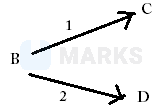
Decay constant is related to half life as, .
, where and are half life for paths and , respectively.
Looking for more such questions to practice?
Download the MARKS App - The ultimate prep app for IIT JEE & NEET with chapter-wise PYQs, revision notes, formula sheets, custom tests & much more.