Search any question & find its solution
Question:
Answered & Verified by Expert
A straight rod of length $L$ is made of a material having mass per unit length $m(x)=\lambda|x|$, where $x$ is measured from the centre of rod. The moment of inertia about an axis perpendicular to the rod and passing through one end of the rod will be $L=1 \mathrm{~m}$ and $\lambda=16 \mathrm{~kg} / \mathrm{m}^2$.
Options:
Solution:
1262 Upvotes
Verified Answer
The correct answer is:
$\1 \mathrm{~kg}-\mathrm{m}^2$
Mass per unit length,
$\frac{d M}{d x}=\lambda|x| \Rightarrow d M=\lambda|x| d x$
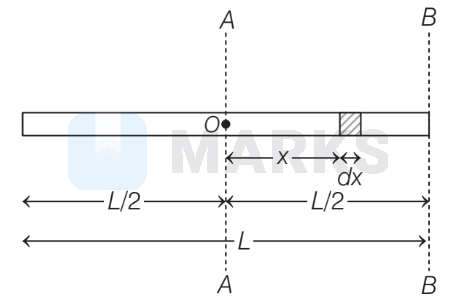
Moment of inertia about axis $A A$
$I_{A A}=\int x^2 d M$
Put the value of $d M$
$\begin{aligned} & I_{A A}=\int_{-L / 2}^{+L / 2} x^2 \times \lambda|x| d x=\int_{-L / 2}^{+L / 2} x^2 \times 16|x| d x \\ & {\left[\because \lambda=16 \mathrm{~kg} / \mathrm{m}^2 \text { (given) }\right]} \\ & =16 \int_{-L / 2}^{+L / 2} x^2|x| d x \\ & =16\left[\int_{-L / 2}^0 x^2(-x) d x+\int_0^{+L / 2} x^2(+x) d x\right] \\ & \because \because x \mid=\left\{\begin{array}{ll}-x & ; \text { if } x < 0 \\ +x & ; \text { if } x \geq 0\end{array}\right] \\ & \end{aligned}$
So,
$\begin{aligned}
I_{A A} & =16\left[\int_{-L / 2}^0\left(-x^3\right) d x+\int_0^{+L / 2}\left(x^3\right) d x\right] \\
& =16\left[-\left[\frac{x^4}{4}\right]_{-L / 2}^0+\left[\frac{x^4}{4}\right]_0^{+L / 2}\right] \\
& =4\left[-\left[x^4\right]_{-L / 2}^0+\left[x^4\right]_0^{+L / 2}\right] \\
& =4\left[-\left\{(0)^4-\left(-\frac{L}{2}\right)^4\right\}+\left\{\left(+\frac{L}{2}\right)^4-(0)^4\right\}\right] \\
& =4\left[-\left\{0-\frac{L^4}{16}\right\}+\left\{\frac{L^4}{16}-0\right\}\right] \\
& =4\left[\frac{L^4}{16}+\frac{L^4}{16}\right]=4\left[\frac{L^4}{8}\right]=\frac{L^4}{2}
\end{aligned}$
Now by the theorem of parallel axes, the moment of inertia about axis $B B$,
$I_{B B}=I_{\mathrm{COM}}+\int\left(\frac{L}{2}\right)^2 d M=I_{\mathrm{COM}}+\frac{L^2}{4} \int d M$
Put the value of $d M$ and $I_{\mathrm{COM}}$
$\begin{array}{r}
I_{B B}=I_{A A}+\frac{L^2}{4} \int_0^{L / 2} \lambda|x| d x=\frac{L^4}{2}+\frac{L^2}{4} \lambda \int_0^{L / 2}|x| d x \\
=\frac{L^4}{2}+\frac{L^2}{4} \times 16 \int_0^{L / 2}(+x) d x \\
{\left[\because \lambda=16 \mathrm{~kg} / \mathrm{m}^2 \text { (given) }\right]}
\end{array}$
$\begin{aligned} & =\frac{L^4}{2}+4 L^2\left[\frac{x^2}{2}\right]_0^{L / 2}=\frac{L^4}{2}+2 L^2\left[x^2\right]_0^{L / 2} \\ & =\frac{L^4}{2}+2 L^2\left[\left(\frac{L}{2}\right)^2-(0)^2\right]=\frac{L^4}{2}+2 L^2\left[\frac{L^2}{4}-0\right] \\ & =\frac{L^4}{2}+\frac{L^4}{2}=L^4=1^4=1 \mathrm{~kg}-\mathrm{m}^2\end{aligned}$
$\frac{d M}{d x}=\lambda|x| \Rightarrow d M=\lambda|x| d x$
Moment of inertia about axis $A A$
$I_{A A}=\int x^2 d M$
Put the value of $d M$
$\begin{aligned} & I_{A A}=\int_{-L / 2}^{+L / 2} x^2 \times \lambda|x| d x=\int_{-L / 2}^{+L / 2} x^2 \times 16|x| d x \\ & {\left[\because \lambda=16 \mathrm{~kg} / \mathrm{m}^2 \text { (given) }\right]} \\ & =16 \int_{-L / 2}^{+L / 2} x^2|x| d x \\ & =16\left[\int_{-L / 2}^0 x^2(-x) d x+\int_0^{+L / 2} x^2(+x) d x\right] \\ & \because \because x \mid=\left\{\begin{array}{ll}-x & ; \text { if } x < 0 \\ +x & ; \text { if } x \geq 0\end{array}\right] \\ & \end{aligned}$
So,
$\begin{aligned}
I_{A A} & =16\left[\int_{-L / 2}^0\left(-x^3\right) d x+\int_0^{+L / 2}\left(x^3\right) d x\right] \\
& =16\left[-\left[\frac{x^4}{4}\right]_{-L / 2}^0+\left[\frac{x^4}{4}\right]_0^{+L / 2}\right] \\
& =4\left[-\left[x^4\right]_{-L / 2}^0+\left[x^4\right]_0^{+L / 2}\right] \\
& =4\left[-\left\{(0)^4-\left(-\frac{L}{2}\right)^4\right\}+\left\{\left(+\frac{L}{2}\right)^4-(0)^4\right\}\right] \\
& =4\left[-\left\{0-\frac{L^4}{16}\right\}+\left\{\frac{L^4}{16}-0\right\}\right] \\
& =4\left[\frac{L^4}{16}+\frac{L^4}{16}\right]=4\left[\frac{L^4}{8}\right]=\frac{L^4}{2}
\end{aligned}$
Now by the theorem of parallel axes, the moment of inertia about axis $B B$,
$I_{B B}=I_{\mathrm{COM}}+\int\left(\frac{L}{2}\right)^2 d M=I_{\mathrm{COM}}+\frac{L^2}{4} \int d M$
Put the value of $d M$ and $I_{\mathrm{COM}}$
$\begin{array}{r}
I_{B B}=I_{A A}+\frac{L^2}{4} \int_0^{L / 2} \lambda|x| d x=\frac{L^4}{2}+\frac{L^2}{4} \lambda \int_0^{L / 2}|x| d x \\
=\frac{L^4}{2}+\frac{L^2}{4} \times 16 \int_0^{L / 2}(+x) d x \\
{\left[\because \lambda=16 \mathrm{~kg} / \mathrm{m}^2 \text { (given) }\right]}
\end{array}$
$\begin{aligned} & =\frac{L^4}{2}+4 L^2\left[\frac{x^2}{2}\right]_0^{L / 2}=\frac{L^4}{2}+2 L^2\left[x^2\right]_0^{L / 2} \\ & =\frac{L^4}{2}+2 L^2\left[\left(\frac{L}{2}\right)^2-(0)^2\right]=\frac{L^4}{2}+2 L^2\left[\frac{L^2}{4}-0\right] \\ & =\frac{L^4}{2}+\frac{L^4}{2}=L^4=1^4=1 \mathrm{~kg}-\mathrm{m}^2\end{aligned}$
Looking for more such questions to practice?
Download the MARKS App - The ultimate prep app for IIT JEE & NEET with chapter-wise PYQs, revision notes, formula sheets, custom tests & much more.