Search any question & find its solution
Question:
Answered & Verified by Expert
A system consists of three particles each of mass ' $\mathrm{m}_1$ ' placed at the corners of an equilateral triangle of side ' $\frac{\mathrm{L}}{3}$, A particle of mass ' $\mathrm{m}_2$ ' is placed at the mid point of any one side of the triangle. Due to the system of particles, the force acting on $\mathrm{m}_2$ is
Options:
Solution:
2694 Upvotes
Verified Answer
The correct answer is:
$\frac{12 \mathrm{Gm}_1 \mathrm{~m}_2}{\mathrm{~L}^2}$
From the fig., we can see that the forces due to masses at Q and R cancel each other as they are equal and opposite. The force at $\mathrm{P}$ is only due to $\mathrm{m}_1$.
In $\triangle P Q S$,
$\mathrm{h}=\frac{\mathrm{L}}{3} \cos 30^{\circ}=\frac{\mathrm{L} \sqrt{3}}{6}$
$\therefore \quad$ Force on $\mathrm{m}_2$ due to $\mathrm{m}_1$ at $\mathrm{P}$ is
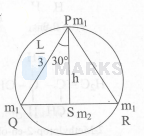
$\begin{aligned} F & =\frac{G m_1 m_2}{\left(\frac{L \sqrt{3}}{6}\right)^2} \\ & =\frac{G m_1 m_2 \cdot 12}{L^2} \\ & =\frac{12 \mathrm{Gm}_1 \mathrm{~m}_2}{\mathrm{~L}^2}\end{aligned}$
In $\triangle P Q S$,
$\mathrm{h}=\frac{\mathrm{L}}{3} \cos 30^{\circ}=\frac{\mathrm{L} \sqrt{3}}{6}$
$\therefore \quad$ Force on $\mathrm{m}_2$ due to $\mathrm{m}_1$ at $\mathrm{P}$ is
$\begin{aligned} F & =\frac{G m_1 m_2}{\left(\frac{L \sqrt{3}}{6}\right)^2} \\ & =\frac{G m_1 m_2 \cdot 12}{L^2} \\ & =\frac{12 \mathrm{Gm}_1 \mathrm{~m}_2}{\mathrm{~L}^2}\end{aligned}$
Looking for more such questions to practice?
Download the MARKS App - The ultimate prep app for IIT JEE & NEET with chapter-wise PYQs, revision notes, formula sheets, custom tests & much more.