Search any question & find its solution
Question:
Answered & Verified by Expert
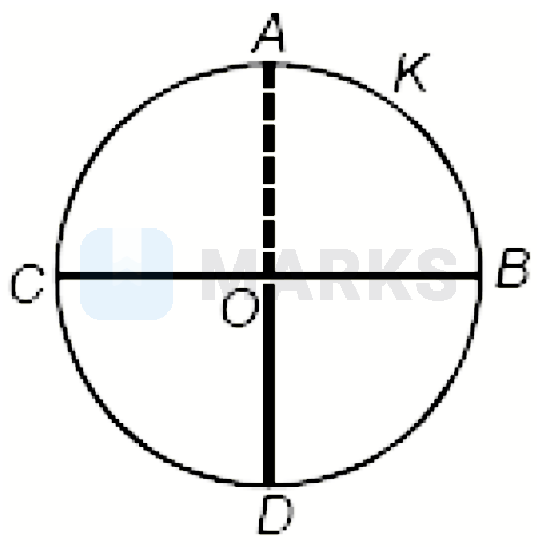
A thin conducting ring of radius $\mathrm{R}$ is given a charge $+\mathrm{Q}$. The electric field at the centre $\mathrm{O}$ of the ring due to the charge on the part $\mathrm{AKB}$ of the ring is $\mathrm{E}$. The electric field at the centre due to the charge on the part $\mathrm{ACDB}$ of the ring is
Options:
Solution:
2335 Upvotes
Verified Answer
The correct answer is:
E along $\mathrm{OK}$
$$
\begin{aligned}
\vec{E}_0 & =0 \\
\Rightarrow \quad \vec{E}_{A K B}+\vec{E}_{A C D B} & =0 \\
\vec{E}_{A C D B} & ={ }^{(-)} \vec{E}_{A K B} \\
& =-E(\text { along } K O) \\
& =E(\text { along } O K)
\end{aligned}
$$
\begin{aligned}
\vec{E}_0 & =0 \\
\Rightarrow \quad \vec{E}_{A K B}+\vec{E}_{A C D B} & =0 \\
\vec{E}_{A C D B} & ={ }^{(-)} \vec{E}_{A K B} \\
& =-E(\text { along } K O) \\
& =E(\text { along } O K)
\end{aligned}
$$
Looking for more such questions to practice?
Download the MARKS App - The ultimate prep app for IIT JEE & NEET with chapter-wise PYQs, revision notes, formula sheets, custom tests & much more.