Search any question & find its solution
Question:
Answered & Verified by Expert
A thin non-conducting ring of radius $r$ has a linear charge density $\lambda=\lambda_0 \cos \phi$, where $\lambda_0$ is a constant and $\phi$ is the azimuthal angle. The magnitude of the electric field strength at the centre of the ring is
Options:
Solution:
2405 Upvotes
Verified Answer
The correct answer is:
$\frac{\lambda_0}{4 \varepsilon_0 r}$
Given that, linear charge density of non-conducting ring $\lambda=\lambda_0 \cos \phi$, and Azimuthal angle $=\phi$
Consider two elements of length $(d l=R d \phi)$ are taken symmetrically at angle $\phi$ on both sides as shown in figure. Here, $d E_1=d E_2$ and $\sin \phi$ components cancelled out each other. Charge on the elements,
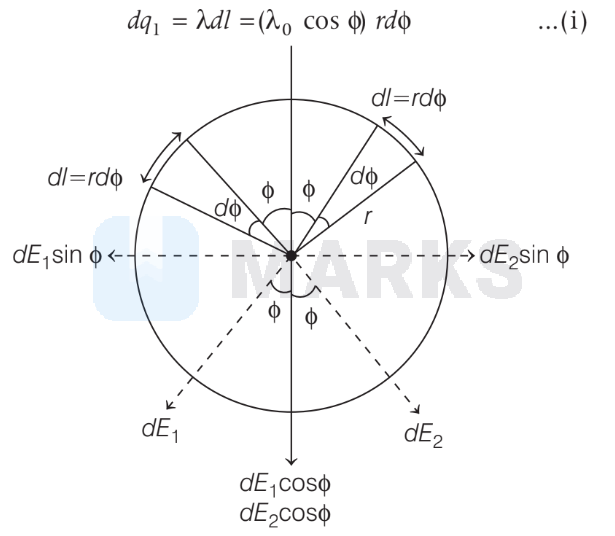
Now, net field at centre of ring due to both elements,
$$
\begin{aligned}
& d E=2 d E_1 \cos \phi \Rightarrow \int_0^E d E=\int_0^\pi 2\left(\frac{d q}{4 \pi \varepsilon_0 r^2}\right) \cos \phi \\
& =\int_0^\pi \frac{2}{4 \pi \varepsilon_0 r^2}\left(\lambda_0 \cos \phi\right)(r d \phi) \cos \phi \quad[\because \text { from Eq. (i) }] \\
& =\frac{2 \lambda_0}{4 \pi \varepsilon_0 r} \int_0^\pi \cos ^2 \phi d \phi=\frac{2 \lambda_0}{4 \pi \varepsilon_0 r} \int_0^{\pi(1+\cos 2 \phi) d \phi} \frac{2}{2} \\
& =\frac{\lambda_0}{4 \pi \varepsilon_0 r}\left[\phi+\frac{\sin 2 \phi}{2}\right]_0^\pi=\frac{\lambda_0}{4 \pi \varepsilon_0 r}[\pi-0] \\
& E=\frac{\lambda_0}{4 \varepsilon_0 r} \\
&
\end{aligned}
$$
Consider two elements of length $(d l=R d \phi)$ are taken symmetrically at angle $\phi$ on both sides as shown in figure. Here, $d E_1=d E_2$ and $\sin \phi$ components cancelled out each other. Charge on the elements,
Now, net field at centre of ring due to both elements,
$$
\begin{aligned}
& d E=2 d E_1 \cos \phi \Rightarrow \int_0^E d E=\int_0^\pi 2\left(\frac{d q}{4 \pi \varepsilon_0 r^2}\right) \cos \phi \\
& =\int_0^\pi \frac{2}{4 \pi \varepsilon_0 r^2}\left(\lambda_0 \cos \phi\right)(r d \phi) \cos \phi \quad[\because \text { from Eq. (i) }] \\
& =\frac{2 \lambda_0}{4 \pi \varepsilon_0 r} \int_0^\pi \cos ^2 \phi d \phi=\frac{2 \lambda_0}{4 \pi \varepsilon_0 r} \int_0^{\pi(1+\cos 2 \phi) d \phi} \frac{2}{2} \\
& =\frac{\lambda_0}{4 \pi \varepsilon_0 r}\left[\phi+\frac{\sin 2 \phi}{2}\right]_0^\pi=\frac{\lambda_0}{4 \pi \varepsilon_0 r}[\pi-0] \\
& E=\frac{\lambda_0}{4 \varepsilon_0 r} \\
&
\end{aligned}
$$
Looking for more such questions to practice?
Download the MARKS App - The ultimate prep app for IIT JEE & NEET with chapter-wise PYQs, revision notes, formula sheets, custom tests & much more.