Search any question & find its solution
Question:
Answered & Verified by Expert
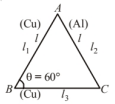
An equilateral triangle $\mathrm{ABC}$ is formed by two $\mathrm{Cu} \operatorname{rods} A B$ and $B C$ and one $\mathrm{Al}$ rod. It is heated in such a way that temperature of each rod increases by $\Delta T$. Find change in the angle $A B C$. [Coeffecient of linear expansion for $\mathrm{Cu}$ is $\alpha_1$, coefficient of linear expansion for $\mathrm{Al}$ is $\alpha_2$ ]
Solution:
1235 Upvotes
Verified Answer
Let us consider the diagram shown,
By trignometry,
Let $l_1=A B, l_2=A C, l_3=B C$
$$
\begin{aligned}
&\therefore \quad \cos \theta=\frac{l_3^2+l_1^2-l_2^2}{2 l_3 l_1} \quad(\text { assume } \angle A B C=\theta) \\
&2 l_3 l_1 \cos \theta=l_3^2+l_1^2-l_2^2
\end{aligned}
$$
Differentiating both side,
$$
\begin{aligned}
&2\left(l_3 d l_1+l_1 d l_3\right) \cos \theta-2 l_1 l_3 \sin \theta d \theta \\
&=2 l_3 d l_1+2 l_1 d l_1-2 l_2 d l_2 \\
&L_t=L_0(1+\alpha \Delta t) \\
&L_t-L_0=L_0 \alpha \Delta t \Rightarrow \Delta L=L_0 \alpha \Delta t
\end{aligned}
$$
Now, $d l_1=l_1 \alpha_1 \Delta t$
(where, $\Delta t=$ change in temperature)
$$
\begin{aligned}
&d l_2=l_2 \alpha{ }_2 \Delta t, d l_3=l_2 \alpha \Delta t \\
&\text { and } l_1=l_2=l_3=l \\
&\text { So, } d l_1=l \alpha \alpha_1 \Delta t, d l_2=l \alpha_2 \Delta t, d l_3=l \alpha_1 \Delta t \\
&\text { Putting their value in (i) } \\
&\left(l^2 \alpha_1 \Delta t+l^2 \alpha_1 \Delta t\right) \cos \theta+l^2 \sin \theta d \theta \\
&=l^2 \alpha_1 \Delta t+l^2 \alpha_1 \Delta t-l^2 \alpha_2 \Delta t \\
&\therefore \theta=60^{\circ} \text { (for equilateral triangle) } \\
&\text { So, } l^2\left(2 \alpha_1 \cos 60^{\circ} \Delta t+\sin 60^{\circ} d \theta\right) \\
&=l^2\left(\alpha_1+\alpha_1-\alpha_2\right) \Delta t \\
&\Rightarrow \quad 2 \alpha_1 \times \frac{1}{2} \Delta t+\frac{\sqrt{3}}{2} d \theta=2 \alpha_1 \Delta t-\alpha_2 \Delta t \\
&\Rightarrow \quad \frac{\sqrt{3}}{2} d \theta=2 \alpha_1 \Delta t-\alpha_1 \Delta t-\alpha_2 \Delta t \\
&\Rightarrow \frac{\sqrt{3}}{2} d \theta=\left(\alpha_1-\alpha_2\right) \Delta t \\
&\Rightarrow d \theta=\frac{2}{\sqrt{3}}\left(\alpha_1-\alpha_2\right) \Delta T \quad(\because \Delta t=\Delta T \text { given }) \\
&
\end{aligned}
$$
By trignometry,
Let $l_1=A B, l_2=A C, l_3=B C$
$$
\begin{aligned}
&\therefore \quad \cos \theta=\frac{l_3^2+l_1^2-l_2^2}{2 l_3 l_1} \quad(\text { assume } \angle A B C=\theta) \\
&2 l_3 l_1 \cos \theta=l_3^2+l_1^2-l_2^2
\end{aligned}
$$
Differentiating both side,
$$
\begin{aligned}
&2\left(l_3 d l_1+l_1 d l_3\right) \cos \theta-2 l_1 l_3 \sin \theta d \theta \\
&=2 l_3 d l_1+2 l_1 d l_1-2 l_2 d l_2 \\
&L_t=L_0(1+\alpha \Delta t) \\
&L_t-L_0=L_0 \alpha \Delta t \Rightarrow \Delta L=L_0 \alpha \Delta t
\end{aligned}
$$
Now, $d l_1=l_1 \alpha_1 \Delta t$
(where, $\Delta t=$ change in temperature)
$$
\begin{aligned}
&d l_2=l_2 \alpha{ }_2 \Delta t, d l_3=l_2 \alpha \Delta t \\
&\text { and } l_1=l_2=l_3=l \\
&\text { So, } d l_1=l \alpha \alpha_1 \Delta t, d l_2=l \alpha_2 \Delta t, d l_3=l \alpha_1 \Delta t \\
&\text { Putting their value in (i) } \\
&\left(l^2 \alpha_1 \Delta t+l^2 \alpha_1 \Delta t\right) \cos \theta+l^2 \sin \theta d \theta \\
&=l^2 \alpha_1 \Delta t+l^2 \alpha_1 \Delta t-l^2 \alpha_2 \Delta t \\
&\therefore \theta=60^{\circ} \text { (for equilateral triangle) } \\
&\text { So, } l^2\left(2 \alpha_1 \cos 60^{\circ} \Delta t+\sin 60^{\circ} d \theta\right) \\
&=l^2\left(\alpha_1+\alpha_1-\alpha_2\right) \Delta t \\
&\Rightarrow \quad 2 \alpha_1 \times \frac{1}{2} \Delta t+\frac{\sqrt{3}}{2} d \theta=2 \alpha_1 \Delta t-\alpha_2 \Delta t \\
&\Rightarrow \quad \frac{\sqrt{3}}{2} d \theta=2 \alpha_1 \Delta t-\alpha_1 \Delta t-\alpha_2 \Delta t \\
&\Rightarrow \frac{\sqrt{3}}{2} d \theta=\left(\alpha_1-\alpha_2\right) \Delta t \\
&\Rightarrow d \theta=\frac{2}{\sqrt{3}}\left(\alpha_1-\alpha_2\right) \Delta T \quad(\because \Delta t=\Delta T \text { given }) \\
&
\end{aligned}
$$
Looking for more such questions to practice?
Download the MARKS App - The ultimate prep app for IIT JEE & NEET with chapter-wise PYQs, revision notes, formula sheets, custom tests & much more.