Search any question & find its solution
Question:
Answered & Verified by Expert
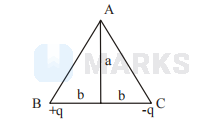
As shown in the figure, charges $+\mathrm{q}$ and $-\mathrm{q}$ are placed at the vertices $\mathrm{B}$ and $\mathrm{C}$ of an isosceles triangle. The potential at the vertex $\mathrm{A}$ is
Options:
Solution:
1784 Upvotes
Verified Answer
The correct answer is:
zero
Potential at A
$=+\frac{q}{\sqrt{a^{2}+b^{2}}}-\frac{q}{\sqrt{a^{2}+b^{2}}}=0$
$=+\frac{q}{\sqrt{a^{2}+b^{2}}}-\frac{q}{\sqrt{a^{2}+b^{2}}}=0$
Looking for more such questions to practice?
Download the MARKS App - The ultimate prep app for IIT JEE & NEET with chapter-wise PYQs, revision notes, formula sheets, custom tests & much more.