Search any question & find its solution
Question:
Answered & Verified by Expert
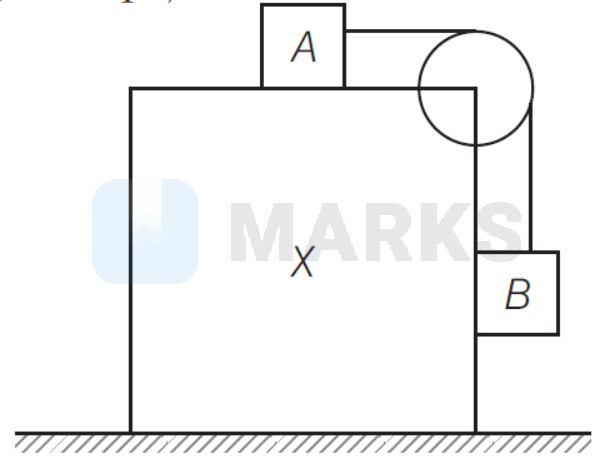
Consider a system of blocks $X, A$ and $B$ as shown in the figure. The blocks $A$ and $B$ have equal mass and are connected by a massless string through a massless pulley. The coefficient of friction between block $A$ and $X$ or $B$ and $X$ is 0.5 . If block $X$ moves on the horizontal frictionless surface what should be Its minimum acceleration such that blocks $A$ and $B$ remain stationary. $(g=$ acceleration due to gravity.)
Options:
Solution:
1327 Upvotes
Verified Answer
The correct answer is:
$\frac{g}{3}$
Given, Mass of block $A$ and $B, m_A=m_B=m$. Coefficient of friction between each block and surface $\mu=0.5$.
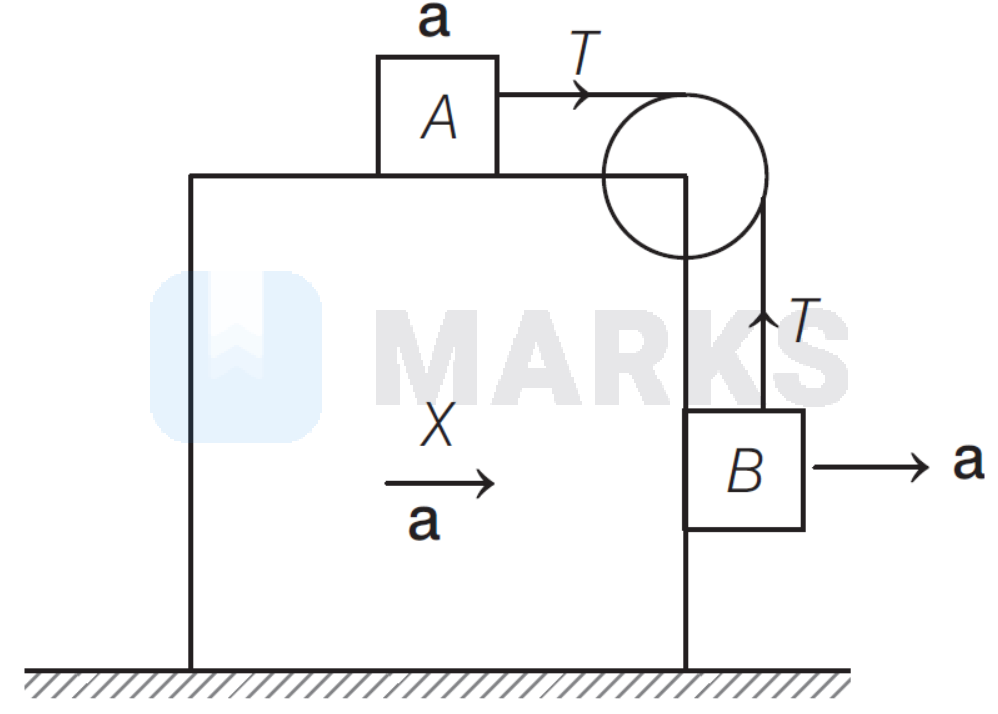
Block $\not X$ moves with acceleration $a$ such that block $A$ and $B$ remains stationary. Block $B$ is stationary only when, Tension force on block $B$ is equal to friction force on $B$.
i.e.,
$$
\begin{aligned}
& T=\mu R \\
& T=\mu m a \quad \text {... (i) }[\because R=m a]
\end{aligned}
$$
(i) $[\because R=m a]$
Block $A$ is stationary only when friction force on block $A$ is equal to the sum of tension force on block $A$ and applied force on block $A$.
$$
\begin{aligned}
\mu R & =T+m a \\
\mu m g & =\mu m a+m a
\end{aligned}
$$
[From Eq. (i),]
$$
\begin{aligned}
\mu g & =\mu a+a \\
\mu g & =a(\mu+1) \\
a=\frac{\mu g}{\mu+1} & =\frac{0.5 g}{0.5+1}=\frac{0.5 g}{1.5}=\frac{g}{3} \\
\therefore \quad & =\frac{g}{3}
\end{aligned}
$$
Thus, $g / 3$ should be its minimum acceleration such that blocks $A$ and $B$ remains stationary.
Block $\not X$ moves with acceleration $a$ such that block $A$ and $B$ remains stationary. Block $B$ is stationary only when, Tension force on block $B$ is equal to friction force on $B$.
i.e.,
$$
\begin{aligned}
& T=\mu R \\
& T=\mu m a \quad \text {... (i) }[\because R=m a]
\end{aligned}
$$
(i) $[\because R=m a]$
Block $A$ is stationary only when friction force on block $A$ is equal to the sum of tension force on block $A$ and applied force on block $A$.
$$
\begin{aligned}
\mu R & =T+m a \\
\mu m g & =\mu m a+m a
\end{aligned}
$$
[From Eq. (i),]
$$
\begin{aligned}
\mu g & =\mu a+a \\
\mu g & =a(\mu+1) \\
a=\frac{\mu g}{\mu+1} & =\frac{0.5 g}{0.5+1}=\frac{0.5 g}{1.5}=\frac{g}{3} \\
\therefore \quad & =\frac{g}{3}
\end{aligned}
$$
Thus, $g / 3$ should be its minimum acceleration such that blocks $A$ and $B$ remains stationary.
Looking for more such questions to practice?
Download the MARKS App - The ultimate prep app for IIT JEE & NEET with chapter-wise PYQs, revision notes, formula sheets, custom tests & much more.