Search any question & find its solution
Question:
Answered & Verified by Expert
If $\mathbf{a}$ and $\mathbf{b}$ represent two non collinear vectors, the equation $\mathbf{r}=t \mathbf{a}+(\mathrm{l}-t) \mathbf{b}$ represents
Options:
Solution:
1625 Upvotes
Verified Answer
The correct answer is:
a point on the third side of a triangle for which $a, b$ are two sides, only when $0 \leq t \leq 1$
We have, $\mathbf{r}=t \mathbf{a}+(\mathbf{l}-t) \mathbf{b}$, where $\mathbf{a}$ and $\mathbf{b}$ are two non collinear vector, $\mathbf{r}-\mathbf{b}=t(\mathbf{a}-\mathbf{b})$
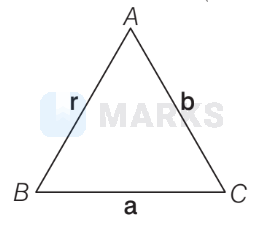
Clearly, $\mathbf{r}$ is a point on the third side of triangle where $\mathbf{a}, \mathbf{b}$ are two sides of triangle when $t \in[0,1]$
Clearly, $\mathbf{r}$ is a point on the third side of triangle where $\mathbf{a}, \mathbf{b}$ are two sides of triangle when $t \in[0,1]$
Looking for more such questions to practice?
Download the MARKS App - The ultimate prep app for IIT JEE & NEET with chapter-wise PYQs, revision notes, formula sheets, custom tests & much more.