Search any question & find its solution
Question:
Answered & Verified by Expert
If the sum of any two roots of the equation $x^3+p x^2+q x+r=0$ is zero, then
Options:
Solution:
1711 Upvotes
Verified Answer
The correct answer is:
$r=p q$
Given equation, $x^3+p x^2+q x+r$
Let roots of given equation are $\alpha, \beta$ and $\gamma$
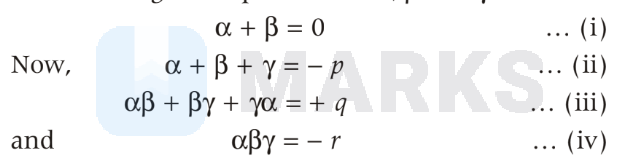
[From Eqs. (i) and (ii)]
$$
\gamma=-p
$$
Substituting this value in Eq. (iv)
$$
\alpha \beta(-p)=-r \Rightarrow \alpha \beta=\frac{r}{p}
$$
Substituting this value in Eq. (iii)
$$
\begin{aligned}
\frac{r}{p}+r(\alpha+\beta) & =+q \\
\frac{r}{p} & =+q \\
r & =p q
\end{aligned} \quad[\because \alpha+\beta=0]
$$
Let roots of given equation are $\alpha, \beta$ and $\gamma$
[From Eqs. (i) and (ii)]
$$
\gamma=-p
$$
Substituting this value in Eq. (iv)
$$
\alpha \beta(-p)=-r \Rightarrow \alpha \beta=\frac{r}{p}
$$
Substituting this value in Eq. (iii)
$$
\begin{aligned}
\frac{r}{p}+r(\alpha+\beta) & =+q \\
\frac{r}{p} & =+q \\
r & =p q
\end{aligned} \quad[\because \alpha+\beta=0]
$$
Looking for more such questions to practice?
Download the MARKS App - The ultimate prep app for IIT JEE & NEET with chapter-wise PYQs, revision notes, formula sheets, custom tests & much more.