Search any question & find its solution
Question:
Answered & Verified by Expert
In an experiment with a potentiometer, $\mathrm{V}_{\mathrm{B}}=10 \mathrm{~V}$. $\mathrm{R}$ is adjusted to be $50 \Omega$ (figure). A student wanting to measure voltage $\mathrm{E}_1$ of a battery (approx. $8 \mathrm{~V}$ ) finds no null point possible. He then diminishes $\mathrm{R}$ to $10 \Omega$ and is able to locate the null point on the last (4th) segment of the potentiometer. Find the resistance of the potentiometer wire and potential drop per unit length across the wire in the second case.
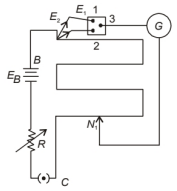
Solution:
2081 Upvotes
Verified Answer
Consider $R^{\prime}$ be the resistance of the potentiometer wire and given variable resistor $(R=50 \Omega)$
Then the effective resistance of potentiometer
$$
=50 \Omega+\mathrm{R}^{\prime}
$$
Effective voltage applied across potentiometer $=10 \mathrm{~V}$ The current through the main circuit,
$$
\begin{aligned}
\mathrm{I} &=\frac{\mathrm{V}}{50 \Omega+\mathrm{R}^{\prime}} \\
&=\frac{10}{50 \Omega+\mathrm{R}^{\prime}}
\end{aligned}
$$
Potential difference across wire of potentiometer,
$$
I^{\prime}=\frac{10 R^{\prime}}{50 \Omega+R^{\prime}}
$$
As, with $50 \Omega$ resistor, null point can not obtained by 8 volt it's possible only when
$$
\frac{10 \times \mathrm{R}^{\prime}}{50+\mathrm{R}^{\prime}} < 8
$$
So, $\quad 10 \mathrm{R}^{\prime} < 400+8 \mathrm{R}^{\prime}$
$$
2 \mathrm{R}^{\prime} < 400 \text { or } \mathrm{R}^{\prime} < 200 \Omega
$$
Similarly with $10 \Omega$ resistor, null point is obtained at $V^{\prime}>8$ its possible only when
$$
\frac{10 \times R^{\prime}}{10+R^{\prime}}>8
$$
So, $\quad 2 R^{\prime}>80, \quad R^{\prime}>40$
As the null point is obtained on 4th segment or at $\left(\frac{3}{4}\right)$ of total length so at $\left(\frac{3}{4} R^{\prime}\right)$.
$$
\begin{aligned}
\frac{10 \times \frac{3}{4} R^{\prime}}{10+R^{\prime}} & < 8 \\
7.5 R^{\prime} & < 80+8 R^{\prime} \\
R^{\prime} &>160 \\
160 < R^{\prime} < 200
\end{aligned}
$$
So,
(At balance point)
Any R' between $160 \Omega$ and $200 \Omega$ will achieve.
Since, the null point on the last (4th) segment of the potentiometer, therefore potential drop across $400 \mathrm{~cm}$ of wire $>8 \mathrm{~V}$.
This imply that potential gradient
or
$$
\begin{aligned}
\mathrm{k} \times 400 \mathrm{~cm} &>8 \mathrm{~V} \quad \text { (at balance point) } \\
\mathrm{k} \times 4 \mathrm{~m} &>8 \mathrm{~V} \\
\mathrm{k}>2 \mathrm{~V} / \mathrm{m}
\end{aligned}
$$
Similarly, potential drop across $300 \mathrm{~cm}$ wire $ < 8 \mathrm{~V}$
$$
\mathrm{k} \times 300 \mathrm{~cm} < 8 \mathrm{~V}
$$
$$
\begin{aligned}
\mathrm{k} \times 3 \mathrm{~m} & < 8 \mathrm{~V} \\
\mathrm{k} & < \frac{8}{3} \mathrm{~V} / \mathrm{m}
\end{aligned}
$$
Hence, $\frac{8}{3} V / m>k>2 V / m$
Then the effective resistance of potentiometer
$$
=50 \Omega+\mathrm{R}^{\prime}
$$
Effective voltage applied across potentiometer $=10 \mathrm{~V}$ The current through the main circuit,
$$
\begin{aligned}
\mathrm{I} &=\frac{\mathrm{V}}{50 \Omega+\mathrm{R}^{\prime}} \\
&=\frac{10}{50 \Omega+\mathrm{R}^{\prime}}
\end{aligned}
$$
Potential difference across wire of potentiometer,
$$
I^{\prime}=\frac{10 R^{\prime}}{50 \Omega+R^{\prime}}
$$
As, with $50 \Omega$ resistor, null point can not obtained by 8 volt it's possible only when
$$
\frac{10 \times \mathrm{R}^{\prime}}{50+\mathrm{R}^{\prime}} < 8
$$
So, $\quad 10 \mathrm{R}^{\prime} < 400+8 \mathrm{R}^{\prime}$
$$
2 \mathrm{R}^{\prime} < 400 \text { or } \mathrm{R}^{\prime} < 200 \Omega
$$
Similarly with $10 \Omega$ resistor, null point is obtained at $V^{\prime}>8$ its possible only when
$$
\frac{10 \times R^{\prime}}{10+R^{\prime}}>8
$$
So, $\quad 2 R^{\prime}>80, \quad R^{\prime}>40$
As the null point is obtained on 4th segment or at $\left(\frac{3}{4}\right)$ of total length so at $\left(\frac{3}{4} R^{\prime}\right)$.
$$
\begin{aligned}
\frac{10 \times \frac{3}{4} R^{\prime}}{10+R^{\prime}} & < 8 \\
7.5 R^{\prime} & < 80+8 R^{\prime} \\
R^{\prime} &>160 \\
160 < R^{\prime} < 200
\end{aligned}
$$
So,
(At balance point)
Any R' between $160 \Omega$ and $200 \Omega$ will achieve.
Since, the null point on the last (4th) segment of the potentiometer, therefore potential drop across $400 \mathrm{~cm}$ of wire $>8 \mathrm{~V}$.
This imply that potential gradient
or
$$
\begin{aligned}
\mathrm{k} \times 400 \mathrm{~cm} &>8 \mathrm{~V} \quad \text { (at balance point) } \\
\mathrm{k} \times 4 \mathrm{~m} &>8 \mathrm{~V} \\
\mathrm{k}>2 \mathrm{~V} / \mathrm{m}
\end{aligned}
$$
Similarly, potential drop across $300 \mathrm{~cm}$ wire $ < 8 \mathrm{~V}$
$$
\mathrm{k} \times 300 \mathrm{~cm} < 8 \mathrm{~V}
$$
$$
\begin{aligned}
\mathrm{k} \times 3 \mathrm{~m} & < 8 \mathrm{~V} \\
\mathrm{k} & < \frac{8}{3} \mathrm{~V} / \mathrm{m}
\end{aligned}
$$
Hence, $\frac{8}{3} V / m>k>2 V / m$
Looking for more such questions to practice?
Download the MARKS App - The ultimate prep app for IIT JEE & NEET with chapter-wise PYQs, revision notes, formula sheets, custom tests & much more.