Search any question & find its solution
Question:
Answered & Verified by Expert
Let $P(3,2,6)$ be a point in space and $Q$ be a point on the line $\mathbf{r}=(\hat{\mathbf{i}}-\hat{\mathbf{j}}+2 \hat{\mathbf{k}})+\mu(-3 \hat{\mathbf{i}}+\hat{\mathbf{j}}+5 \hat{\mathbf{k}})$.
Then, the value of $\mu$ for which the vector $\mathbf{P Q}$ is parallel to the plane $x-4 y+3 z=1$ is
Options:
Then, the value of $\mu$ for which the vector $\mathbf{P Q}$ is parallel to the plane $x-4 y+3 z=1$ is
Solution:
1146 Upvotes
Verified Answer
The correct answer is:
$1 / 4$
$1 / 4$
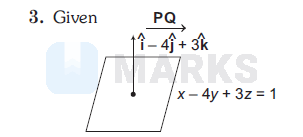
$\mathbf{O Q}=(1-3 \mu) \mathbf{i}+(\mu-1) \mathbf{j}+(5 \mu+2) \mathbf{k}$ and $\mathbf{O P}=3 \hat{\mathbf{i}}+2 \hat{\mathbf{j}}+6 \hat{\mathbf{k}}$, where $O$ is origin.
$$
\begin{aligned}
& \text { Now, } \mathbf{P Q}=(1-3 \mu-3) \hat{\mathbf{i}}+(\mu-1-2) \hat{\mathbf{j}} \\
& +(5 \mu+2-6) \hat{\mathbf{k}} \\
& =(2-3 \mu) \hat{\mathbf{i}}+(\mu-3) \hat{\mathbf{j}}+(5 \mu-4) \hat{\mathbf{k}} \\
&
\end{aligned}
$$
$\because \mathbf{P Q}$ is parallel to the plane
$$
\begin{array}{rr}
& x-4 y+3 z=1 . \\
\therefore & -2-3 \mu-4 \mu+12+15 \mu-12=0 \\
\Rightarrow & 8 \mu=2 \Rightarrow \mu=\frac{1}{4}
\end{array}
$$
Looking for more such questions to practice?
Download the MARKS App - The ultimate prep app for IIT JEE & NEET with chapter-wise PYQs, revision notes, formula sheets, custom tests & much more.