Search any question & find its solution
Question:
Answered & Verified by Expert
$$
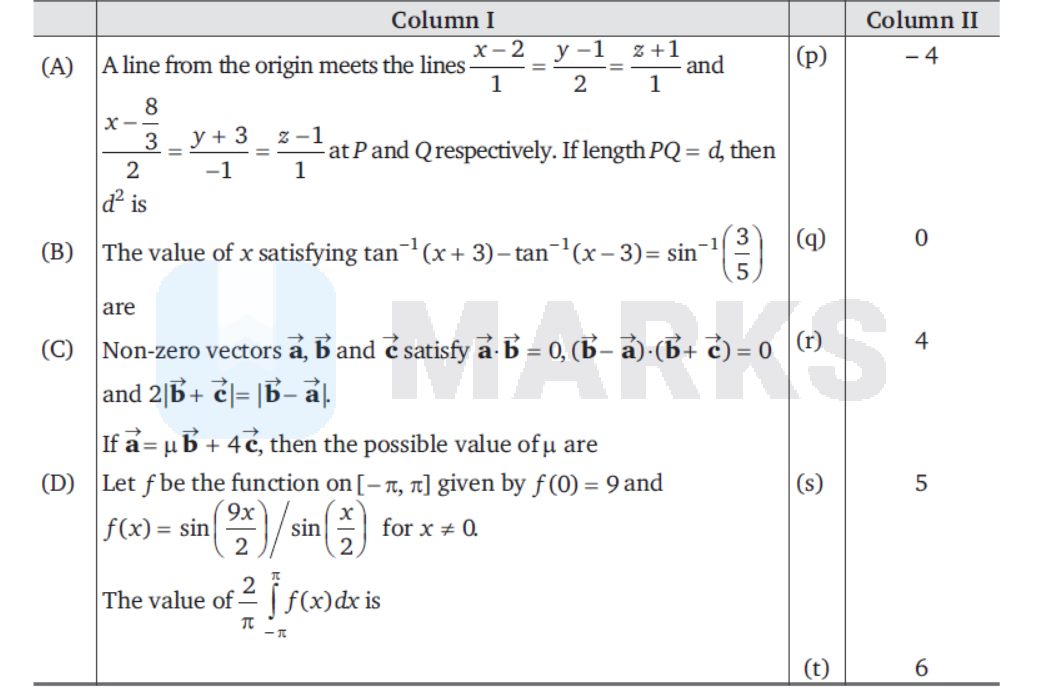
\text { Match the statements of Column I with values of Column II. }
$$
Options:
\text { Match the statements of Column I with values of Column II. }
$$
Solution:
1922 Upvotes
Verified Answer
The correct answer is:
(A) t, (B) p,r, (C) p, (D) r
(A) t, (B) p,r, (C) p, (D) r
(A) Equation of the line passing through origin is
$$
\begin{aligned}
& \frac{x}{a}=\frac{y}{b}=\frac{z}{c} \\
& \therefore \quad\left|\begin{array}{ccc}
2 & 1 & -1 \\
1 & -2 & 1 \\
a & b & c
\end{array}\right|=0 \\
& \Rightarrow \quad a(-1)-b(3)+c(-5)=0 \\
& \Rightarrow \quad-a-3 b-5 c=0 \\
& \Rightarrow \quad a+3 b+5 c=0 \\
& \text { Also, } \quad\left|\begin{array}{ccc}
\frac{8}{3} & -3 & 1 \\
2 & -1 & 1 \\
a & b & c
\end{array}\right|=0
\end{aligned}
$$
$$
\begin{aligned}
& \therefore \quad a(-2)-b\left(\frac{2}{3}\right)+c\left(\frac{10}{3}\right)=0 \\
& \Rightarrow \quad 2 a+\frac{2 b}{3}-\frac{10 c}{3}=0 \\
& 3 a+b-5 c=0 \\
&
\end{aligned}
$$
From Eqs. (i) and (ii),
$$
\begin{aligned}
\frac{a}{-20} & =\frac{b}{20}=\frac{c}{-8} \\
\frac{a}{5} & =\frac{b}{-5}=\frac{c}{4}
\end{aligned}
$$
Equation of line is
$$
\frac{x}{5}=\frac{y}{-5}=\frac{z}{4}=\lambda \text { (say) }
$$
Also, $\frac{x-2}{1}=\frac{y-1}{2}=\frac{z+1}{1}=k_1$ (say)
Now, $\frac{x-\frac{8}{3}}{2}=\frac{y+3}{-1}=\frac{z-1}{1}=k_2$ (say)
Point on (iii) is $(5 \lambda,-5 \lambda,+4 \lambda)$ Point on (iv) is
$$
\left(2+k_1, 1-2 k_1,-1+k_1\right)
$$
Point on $(\mathrm{v})$ is
$$
\left(\frac{8}{3}+2 k_2,-3-k_2, 1+k_2\right)
$$
On solving, $2+k_1+1-2 k_1=0$
$$
-k_1+3=0
$$
$$
\begin{aligned}
k_1 & =3 \\
P & \equiv(5,-5,2)
\end{aligned}
$$
Again, for $Q$
$$
\begin{array}{r}
\frac{8}{3}+2 k_2-3-k_2=0 \\
k_2-\frac{1}{3}=0 \\
k_2=\frac{1}{3} \\
Q \equiv\left(\frac{10}{3}, \frac{-10}{3}, \frac{4}{3}\right)
\end{array}
$$
$$
\text { Now, } \begin{aligned}
P Q & =\sqrt{\left(\frac{5}{3}\right)^2+\left(\frac{5}{3}\right)^2+\left(\frac{2}{3}\right)^2} \\
& =\frac{\sqrt{54}}{3}
\end{aligned}
$$
$$
P Q^2=d^2=\frac{54}{9}=6
$$
(B) $\tan ^{-1}\left(\frac{x+3-x+3}{1+\left(x^2-9\right)}\right)=\tan ^{-1}\left(\frac{3}{4}\right)$
$$
\begin{array}{rlrl}
\Rightarrow & & \frac{6}{x^2-8} & =\frac{3}{4} \\
\Rightarrow & & 3 x^2 & =48 \\
\Rightarrow & x & =\pm 4
\end{array}
$$
(C)
$$
\begin{aligned}
& (\overrightarrow{\mathbf{b}}-\overrightarrow{\mathbf{a}}) \cdot\left(\overrightarrow{\mathbf{b}}+\frac{\overrightarrow{\mathbf{a}}-\mu \overrightarrow{\mathbf{b}}}{4}\right)=0 \\
& \Rightarrow \quad(\overrightarrow{\mathbf{b}}-\overrightarrow{\mathbf{a}}) \cdot(4 \overrightarrow{\mathbf{b}}+\overrightarrow{\mathbf{a}}-\mu \overrightarrow{\mathbf{b}})=0 \\
& \text { Also, } 2\left|\overrightarrow{\mathbf{b}}+\frac{\overrightarrow{\mathbf{a}}-\mu \overrightarrow{\mathbf{b}}}{4}\right|=|\overrightarrow{\mathbf{b}}-\overrightarrow{\mathbf{a}}| \\
& \Rightarrow \quad 2\left|\frac{(4-\mu) \overrightarrow{\mathbf{b}}^2-\overrightarrow{\mathbf{a}}^2=0}{4}\right|=|\overrightarrow{\mathbf{b}}-\overrightarrow{\mathbf{a}}|
\end{aligned}
$$
$$
\begin{aligned}
& \Rightarrow \frac{(4-\mu)^2 \overrightarrow{\mathbf{b}}^2}{4}+\frac{\overrightarrow{\mathbf{a}}^2}{4}=\overrightarrow{\mathbf{b}}^2+\overrightarrow{\mathbf{a}}^2 \\
& \Rightarrow \quad \frac{3 \overrightarrow{\mathbf{a}}^2}{4}=\frac{(4-\mu)^2-4}{4} \cdot \overrightarrow{\mathbf{a}}^2 \\
& 3 \overrightarrow{\mathbf{a}}^2=C(4-\mu)^2-4 \overrightarrow{\mathbf{b}}^2
\end{aligned}
$$
From Eqs. (i) and (ii)
$$
\begin{aligned}
& 3(4-\mu)=(4-\mu)^2-4 \\
& (4-\mu)^2-3(4-\mu)-4=0 \\
& \Rightarrow \quad \mu=0,5 \\
& \mu=5 \text { is not admissible. }
\end{aligned}
$$
(D) $f(0)=9$,
$$
\begin{aligned}
& f(x)=\frac{\sin \left(\frac{9 x}{2}\right)}{\sin \frac{x}{2}} \\
& =\left(3-4 \sin ^2 \frac{x}{2}\right)\left(3-4 \sin ^2 \frac{3 x}{2}\right)
\end{aligned}
$$
$$
\begin{aligned}
& =9-12 \sin ^2 \frac{x}{2}-12 \sin ^2 \frac{3 x}{2} \\
& \quad+16 \sin ^2 \frac{x}{2} \cdot \sin ^2 \frac{3 x}{2} \\
& =9-6(1-\cos x)-6(1-\cos 3 x) \\
& \quad+4(1-\cos x)(1-\cos 3 x) \\
& =1+6 \cos x+6 \cos 3 x-4 \cos x \\
& \quad-4 \cos 3 x+4 \cos x \cos 3 x \\
& \text { Let } \quad I=\frac{2}{\pi} \int_{-\pi}^\pi \frac{\sin \frac{9 x}{2}}{2} d x \\
& =\frac{4}{\pi} \int_0^\pi 1+2 \cos x+2 \cos 3 x \\
& =\frac{4}{\pi} \times \pi \quad+2(\cos 4 x+\cos x) d x \\
& =4
\end{aligned}
$$
$$
\begin{aligned}
& \frac{x}{a}=\frac{y}{b}=\frac{z}{c} \\
& \therefore \quad\left|\begin{array}{ccc}
2 & 1 & -1 \\
1 & -2 & 1 \\
a & b & c
\end{array}\right|=0 \\
& \Rightarrow \quad a(-1)-b(3)+c(-5)=0 \\
& \Rightarrow \quad-a-3 b-5 c=0 \\
& \Rightarrow \quad a+3 b+5 c=0 \\
& \text { Also, } \quad\left|\begin{array}{ccc}
\frac{8}{3} & -3 & 1 \\
2 & -1 & 1 \\
a & b & c
\end{array}\right|=0
\end{aligned}
$$
$$
\begin{aligned}
& \therefore \quad a(-2)-b\left(\frac{2}{3}\right)+c\left(\frac{10}{3}\right)=0 \\
& \Rightarrow \quad 2 a+\frac{2 b}{3}-\frac{10 c}{3}=0 \\
& 3 a+b-5 c=0 \\
&
\end{aligned}
$$
From Eqs. (i) and (ii),
$$
\begin{aligned}
\frac{a}{-20} & =\frac{b}{20}=\frac{c}{-8} \\
\frac{a}{5} & =\frac{b}{-5}=\frac{c}{4}
\end{aligned}
$$
Equation of line is
$$
\frac{x}{5}=\frac{y}{-5}=\frac{z}{4}=\lambda \text { (say) }
$$
Also, $\frac{x-2}{1}=\frac{y-1}{2}=\frac{z+1}{1}=k_1$ (say)
Now, $\frac{x-\frac{8}{3}}{2}=\frac{y+3}{-1}=\frac{z-1}{1}=k_2$ (say)
Point on (iii) is $(5 \lambda,-5 \lambda,+4 \lambda)$ Point on (iv) is
$$
\left(2+k_1, 1-2 k_1,-1+k_1\right)
$$
Point on $(\mathrm{v})$ is
$$
\left(\frac{8}{3}+2 k_2,-3-k_2, 1+k_2\right)
$$
On solving, $2+k_1+1-2 k_1=0$
$$
-k_1+3=0
$$
$$
\begin{aligned}
k_1 & =3 \\
P & \equiv(5,-5,2)
\end{aligned}
$$
Again, for $Q$
$$
\begin{array}{r}
\frac{8}{3}+2 k_2-3-k_2=0 \\
k_2-\frac{1}{3}=0 \\
k_2=\frac{1}{3} \\
Q \equiv\left(\frac{10}{3}, \frac{-10}{3}, \frac{4}{3}\right)
\end{array}
$$
$$
\text { Now, } \begin{aligned}
P Q & =\sqrt{\left(\frac{5}{3}\right)^2+\left(\frac{5}{3}\right)^2+\left(\frac{2}{3}\right)^2} \\
& =\frac{\sqrt{54}}{3}
\end{aligned}
$$
$$
P Q^2=d^2=\frac{54}{9}=6
$$
(B) $\tan ^{-1}\left(\frac{x+3-x+3}{1+\left(x^2-9\right)}\right)=\tan ^{-1}\left(\frac{3}{4}\right)$
$$
\begin{array}{rlrl}
\Rightarrow & & \frac{6}{x^2-8} & =\frac{3}{4} \\
\Rightarrow & & 3 x^2 & =48 \\
\Rightarrow & x & =\pm 4
\end{array}
$$
(C)
$$
\begin{aligned}
& (\overrightarrow{\mathbf{b}}-\overrightarrow{\mathbf{a}}) \cdot\left(\overrightarrow{\mathbf{b}}+\frac{\overrightarrow{\mathbf{a}}-\mu \overrightarrow{\mathbf{b}}}{4}\right)=0 \\
& \Rightarrow \quad(\overrightarrow{\mathbf{b}}-\overrightarrow{\mathbf{a}}) \cdot(4 \overrightarrow{\mathbf{b}}+\overrightarrow{\mathbf{a}}-\mu \overrightarrow{\mathbf{b}})=0 \\
& \text { Also, } 2\left|\overrightarrow{\mathbf{b}}+\frac{\overrightarrow{\mathbf{a}}-\mu \overrightarrow{\mathbf{b}}}{4}\right|=|\overrightarrow{\mathbf{b}}-\overrightarrow{\mathbf{a}}| \\
& \Rightarrow \quad 2\left|\frac{(4-\mu) \overrightarrow{\mathbf{b}}^2-\overrightarrow{\mathbf{a}}^2=0}{4}\right|=|\overrightarrow{\mathbf{b}}-\overrightarrow{\mathbf{a}}|
\end{aligned}
$$
$$
\begin{aligned}
& \Rightarrow \frac{(4-\mu)^2 \overrightarrow{\mathbf{b}}^2}{4}+\frac{\overrightarrow{\mathbf{a}}^2}{4}=\overrightarrow{\mathbf{b}}^2+\overrightarrow{\mathbf{a}}^2 \\
& \Rightarrow \quad \frac{3 \overrightarrow{\mathbf{a}}^2}{4}=\frac{(4-\mu)^2-4}{4} \cdot \overrightarrow{\mathbf{a}}^2 \\
& 3 \overrightarrow{\mathbf{a}}^2=C(4-\mu)^2-4 \overrightarrow{\mathbf{b}}^2
\end{aligned}
$$
From Eqs. (i) and (ii)
$$
\begin{aligned}
& 3(4-\mu)=(4-\mu)^2-4 \\
& (4-\mu)^2-3(4-\mu)-4=0 \\
& \Rightarrow \quad \mu=0,5 \\
& \mu=5 \text { is not admissible. }
\end{aligned}
$$
(D) $f(0)=9$,
$$
\begin{aligned}
& f(x)=\frac{\sin \left(\frac{9 x}{2}\right)}{\sin \frac{x}{2}} \\
& =\left(3-4 \sin ^2 \frac{x}{2}\right)\left(3-4 \sin ^2 \frac{3 x}{2}\right)
\end{aligned}
$$
$$
\begin{aligned}
& =9-12 \sin ^2 \frac{x}{2}-12 \sin ^2 \frac{3 x}{2} \\
& \quad+16 \sin ^2 \frac{x}{2} \cdot \sin ^2 \frac{3 x}{2} \\
& =9-6(1-\cos x)-6(1-\cos 3 x) \\
& \quad+4(1-\cos x)(1-\cos 3 x) \\
& =1+6 \cos x+6 \cos 3 x-4 \cos x \\
& \quad-4 \cos 3 x+4 \cos x \cos 3 x \\
& \text { Let } \quad I=\frac{2}{\pi} \int_{-\pi}^\pi \frac{\sin \frac{9 x}{2}}{2} d x \\
& =\frac{4}{\pi} \int_0^\pi 1+2 \cos x+2 \cos 3 x \\
& =\frac{4}{\pi} \times \pi \quad+2(\cos 4 x+\cos x) d x \\
& =4
\end{aligned}
$$
Looking for more such questions to practice?
Download the MARKS App - The ultimate prep app for IIT JEE & NEET with chapter-wise PYQs, revision notes, formula sheets, custom tests & much more.