Search any question & find its solution
Question:
Answered & Verified by Expert
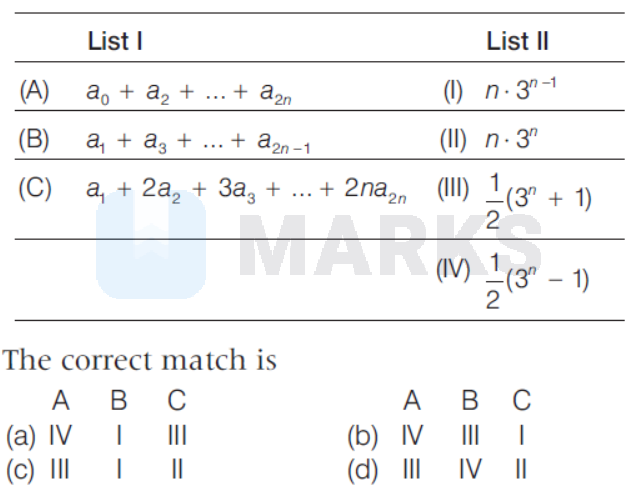
Solution:
1146 Upvotes
Verified Answer
The correct answer is:
(d)
We have,
$$
\left(1+x+x^2\right)^n=a_0+a_1 x+a_2 x^2+\ldots+a_{2 n} x^{2 n}
$$
Put $x=1$, we get
$$
3^n=a_0+a_1+a_2+a_3+\ldots+a_2 n
$$
Put $x=i^2$, we get
$$
1=a_0+a_1+a_2+a_3+\ldots+a_{2 n}
$$
Adding Eqs. (i) and (ii), we get
$$
\begin{aligned}
& 3^n+1=2\left(a_0+a_2+a_4+\ldots+a_{2 n}\right) \\
\therefore \quad & a_0+a_2+a_4+\ldots+a_{2 n}=\frac{1}{2}\left(3^n+1\right)
\end{aligned}
$$
Subtract Eq. (ii)/from Eq. (i) we get
$$
\begin{aligned}
& a_1+a_3+a_5+\ldots+a_{2 n-1}=\frac{1}{2}\left(3^n-1\right) \\
& \left(1+x+x^2\right)^n=a_0+a_1 x+a_2 x^2+\ldots+a_{2 n} x^{2 n}
\end{aligned}
$$
On differentiating both side with respect to $x$ we get
$$
\begin{aligned}
n\left(1+x+x^2\right)^{n-1}(1+2 x)=a_1 & +2 a_2 x+3 a_3 x^2 \\
& +\ldots+2 n a_{2 n} x^{2 n-1}
\end{aligned}
$$
put $x=1$ we get
$$
\begin{array}{ll}
& n \cdot 3^n=a_1+2 a_2+3 a_3+\ldots+2 n a_{2 n} \\
\therefore \quad & \mathrm{A} \rightarrow \mathrm{III}, \mathrm{B} \rightarrow \mathrm{IV}, \mathrm{C} \rightarrow \mathrm{II}
\end{array}
$$
$$
\left(1+x+x^2\right)^n=a_0+a_1 x+a_2 x^2+\ldots+a_{2 n} x^{2 n}
$$
Put $x=1$, we get
$$
3^n=a_0+a_1+a_2+a_3+\ldots+a_2 n
$$
Put $x=i^2$, we get
$$
1=a_0+a_1+a_2+a_3+\ldots+a_{2 n}
$$
Adding Eqs. (i) and (ii), we get
$$
\begin{aligned}
& 3^n+1=2\left(a_0+a_2+a_4+\ldots+a_{2 n}\right) \\
\therefore \quad & a_0+a_2+a_4+\ldots+a_{2 n}=\frac{1}{2}\left(3^n+1\right)
\end{aligned}
$$
Subtract Eq. (ii)/from Eq. (i) we get
$$
\begin{aligned}
& a_1+a_3+a_5+\ldots+a_{2 n-1}=\frac{1}{2}\left(3^n-1\right) \\
& \left(1+x+x^2\right)^n=a_0+a_1 x+a_2 x^2+\ldots+a_{2 n} x^{2 n}
\end{aligned}
$$
On differentiating both side with respect to $x$ we get
$$
\begin{aligned}
n\left(1+x+x^2\right)^{n-1}(1+2 x)=a_1 & +2 a_2 x+3 a_3 x^2 \\
& +\ldots+2 n a_{2 n} x^{2 n-1}
\end{aligned}
$$
put $x=1$ we get
$$
\begin{array}{ll}
& n \cdot 3^n=a_1+2 a_2+3 a_3+\ldots+2 n a_{2 n} \\
\therefore \quad & \mathrm{A} \rightarrow \mathrm{III}, \mathrm{B} \rightarrow \mathrm{IV}, \mathrm{C} \rightarrow \mathrm{II}
\end{array}
$$
Looking for more such questions to practice?
Download the MARKS App - The ultimate prep app for IIT JEE & NEET with chapter-wise PYQs, revision notes, formula sheets, custom tests & much more.