Search any question & find its solution
Question:
Answered & Verified by Expert
Paragraph:
Read the following passage and answer the questions.
Let $A B C D$ be a square of side length 2 units. $C_2$ is the circle through vertices $A, B, C, D$ and $C_1$ is the circle touching all the sides of square $A B C D$. $L$ is the line through $A$.Question:
If $P$ is a point on $C_1$ and $Q$ is a point on $C_2$, then $\frac{P A^2+P B^2+P C^2+P D^2}{Q A^2+Q B^2+Q C^2+Q D^2}$ is equal to
Options:
Read the following passage and answer the questions.
Let $A B C D$ be a square of side length 2 units. $C_2$ is the circle through vertices $A, B, C, D$ and $C_1$ is the circle touching all the sides of square $A B C D$. $L$ is the line through $A$.Question:
If $P$ is a point on $C_1$ and $Q$ is a point on $C_2$, then $\frac{P A^2+P B^2+P C^2+P D^2}{Q A^2+Q B^2+Q C^2+Q D^2}$ is equal to
Solution:
1897 Upvotes
Verified Answer
The correct answer is:
$0.75$
$0.75$
$$
\text { Here, equation of } C_2:(x-1)^2+(y-1)^2=(\sqrt{2})^2 \text { and } C_1:(x-1)^2+(y-1)^2=(1)^2
$$
$$
\begin{aligned}
& \therefore P(1+\cos \theta, 1+\sin \theta) \\
& \text { and } Q(1+\sqrt{2} \sin \theta, 1+\sqrt{2} \sin \theta) \\
& \therefore P A^2+P B^2+P C^2+P D^2 \\
& =\left\{(1+\cos \theta)^2+(1+\sin \theta)^2\right\} \\
& +\left\{(\cos \theta-1)^2+(1+\sin \theta)^2\right\} \\
& +\left\{(1+\cos \theta)^2+(1-\sin \theta)^2\right\} \\
& +\left\{(1-\cos \theta)^2+(1-\sin \theta)^2\right\} \\
& =16 \\
& \therefore \quad \frac{\Sigma Q A^2}{\Sigma P A^2}=\frac{12}{16}=0.75 \\
&
\end{aligned}
$$
Hence (a) is the correct answer.
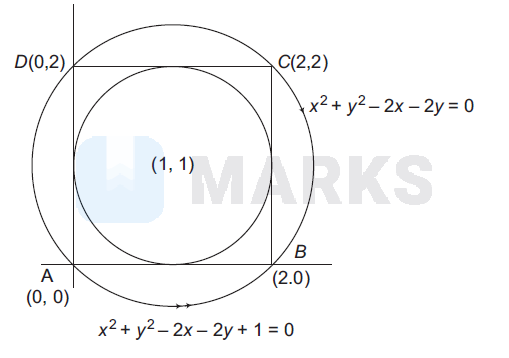
\text { Here, equation of } C_2:(x-1)^2+(y-1)^2=(\sqrt{2})^2 \text { and } C_1:(x-1)^2+(y-1)^2=(1)^2
$$
$$
\begin{aligned}
& \therefore P(1+\cos \theta, 1+\sin \theta) \\
& \text { and } Q(1+\sqrt{2} \sin \theta, 1+\sqrt{2} \sin \theta) \\
& \therefore P A^2+P B^2+P C^2+P D^2 \\
& =\left\{(1+\cos \theta)^2+(1+\sin \theta)^2\right\} \\
& +\left\{(\cos \theta-1)^2+(1+\sin \theta)^2\right\} \\
& +\left\{(1+\cos \theta)^2+(1-\sin \theta)^2\right\} \\
& +\left\{(1-\cos \theta)^2+(1-\sin \theta)^2\right\} \\
& =16 \\
& \therefore \quad \frac{\Sigma Q A^2}{\Sigma P A^2}=\frac{12}{16}=0.75 \\
&
\end{aligned}
$$
Hence (a) is the correct answer.
Looking for more such questions to practice?
Download the MARKS App - The ultimate prep app for IIT JEE & NEET with chapter-wise PYQs, revision notes, formula sheets, custom tests & much more.