Search any question & find its solution
Question:
Answered & Verified by Expert
Paragraph:
The nuclear charge $(\mathrm{Ze})$ is non-uniformly distributed within a nucleus of radius $R$. The charge density $\rho(r)$ [charge per unit volume] is dependent only on the radial distance $r$ from the centre of the nucleus as shown in figure. The electric field is only along the radial direction.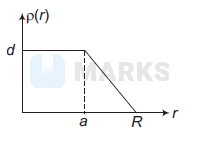
Question:
For $a=0$, the value of $d$ (maximum value of $\rho$ as shown in the figure) is
Options:
The nuclear charge $(\mathrm{Ze})$ is non-uniformly distributed within a nucleus of radius $R$. The charge density $\rho(r)$ [charge per unit volume] is dependent only on the radial distance $r$ from the centre of the nucleus as shown in figure. The electric field is only along the radial direction.
Question:
For $a=0$, the value of $d$ (maximum value of $\rho$ as shown in the figure) is
Solution:
1612 Upvotes
Verified Answer
The correct answer is:
$\frac{3 Z e}{\pi R^3}$
$\frac{3 Z e}{\pi R^3}$
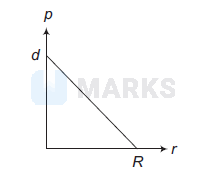
For $a=0$
$$
\begin{aligned}
& \rho(r)=\left(-\frac{d}{R} \cdot r+d\right) \\
& \text { Now } \int_0^R\left(4 \pi r^2\right)\left(d-\frac{d}{R} r\right) d r=\text { net charge }=Z e
\end{aligned}
$$
Solving this equation, we get $d=\frac{3 Z e}{\pi R^3}$
$$
\begin{aligned}
& \rho(r)=\left(-\frac{d}{R} \cdot r+d\right) \\
& \text { Now } \int_0^R\left(4 \pi r^2\right)\left(d-\frac{d}{R} r\right) d r=\text { net charge }=Z e
\end{aligned}
$$
Solving this equation, we get $d=\frac{3 Z e}{\pi R^3}$
Looking for more such questions to practice?
Download the MARKS App - The ultimate prep app for IIT JEE & NEET with chapter-wise PYQs, revision notes, formula sheets, custom tests & much more.