Search any question & find its solution
Question:
Answered & Verified by Expert
Rays from a point source of light situated at height $h$ below the liquid surface having refractive index $\mu$, forms a circular patch of light of radius $r$ on the surface. The area of the patch is
Options:
Solution:
1596 Upvotes
Verified Answer
The correct answer is:
$\frac{\pi h^2}{\left(\mu^2-1\right)}$
Consider the figure as shown below:
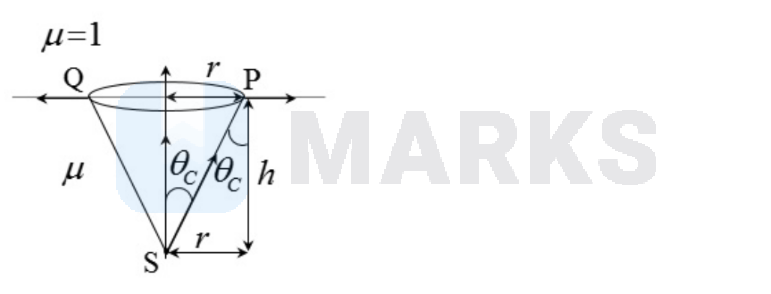
Area of the light patch $=\pi r^2$
We know the patch forms due to total internal reflection. Light rays from source $S$ are incident at the edge of the circular path at critical angle $\theta_{\mathrm{C}}$ (as shown at points $\mathrm{P}$ and $\mathrm{Q}$ ), the refracted ray exits at angle $\frac{\pi}{2}$ w.r.t. the normal.
Using Snell's Law
$$
\begin{aligned}
& \therefore \mu\left(\sin \theta_C\right)=1\left(\sin \left(\frac{\pi}{2}\right)\right) \\
& \Rightarrow \sin \theta_C=\frac{1}{\mu}=\frac{r}{\sqrt{h^2+r^2}} \\
& \Rightarrow r^2=\frac{\left(h^2+r^2\right)}{\mu^2} \\
& \Rightarrow r^2=\frac{h^2}{\left(\mu^2-1\right)}
\end{aligned}
$$
$\therefore$ Area of the patch $=\left(\frac{\pi h^2}{\mu^2-1}\right)$
Area of the light patch $=\pi r^2$
We know the patch forms due to total internal reflection. Light rays from source $S$ are incident at the edge of the circular path at critical angle $\theta_{\mathrm{C}}$ (as shown at points $\mathrm{P}$ and $\mathrm{Q}$ ), the refracted ray exits at angle $\frac{\pi}{2}$ w.r.t. the normal.
Using Snell's Law
$$
\begin{aligned}
& \therefore \mu\left(\sin \theta_C\right)=1\left(\sin \left(\frac{\pi}{2}\right)\right) \\
& \Rightarrow \sin \theta_C=\frac{1}{\mu}=\frac{r}{\sqrt{h^2+r^2}} \\
& \Rightarrow r^2=\frac{\left(h^2+r^2\right)}{\mu^2} \\
& \Rightarrow r^2=\frac{h^2}{\left(\mu^2-1\right)}
\end{aligned}
$$
$\therefore$ Area of the patch $=\left(\frac{\pi h^2}{\mu^2-1}\right)$
Looking for more such questions to practice?
Download the MARKS App - The ultimate prep app for IIT JEE & NEET with chapter-wise PYQs, revision notes, formula sheets, custom tests & much more.